Books
The best money management books — for the part of money that is not investing
The seven best money management books for Indian readers — budgeting systems, debt clearance and spending control, with the US-only chapters honestly flagged.
The books on this page
As an Amazon Associate, WealthStem earns from qualifying purchases. The links below go to Amazon.in and carry our affiliate tag — buying through them costs you nothing extra, and the order is the order the article discusses them, never the order that pays most. How we make money.


Prices and editions change on Amazon without notice, which is why none are quoted here. Every listing above was last verified against Amazon.in on 21 August 2026 — if a link ever lands somewhere unexpected, tell us.
Money management is the unglamorous half of personal finance — not which fund to buy, but whether anything is left to invest by the 25th. It is also the half that decides outcomes, because a household that cannot hold on to its surplus has nothing for compounding to work with. The books below are ranked for that job alone: controlling the flow, clearing the debt, running the monthly system.
The selection rule matters here more than anywhere, because this is the corner of the genre most colonised by American assumptions. Debt advice priced for American card interest reads differently in India, where revolving rates run substantially higher; budgeting systems built on US account types need Indian plumbing. Every imported book below carries a note on what to skip, and the two Indian books carry none.
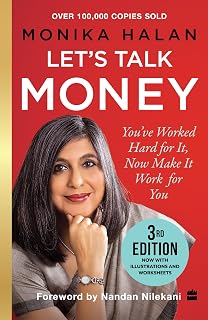
1. Let’s Talk Money — Monika Halan
The best money management system ever written for Indian rails, which is why it tops our full personal finance list too. The heart of the book is pure money management: three accounts — spend, save, invest — with automatic flows between them on salary day, so the system runs on standing instructions instead of discipline. Add her unsentimental treatment of insurance-as-protection and emergency funds and you have the complete operational layer for an Indian salary. If this page could recommend only one book, this is it, and the rest of the list assumes you have read it.
2. The One-Page Financial Plan — Carl Richards
The book for everyone paralysed by the idea that managing money means spreadsheets. Richards — the financial planner behind the famous napkin sketches — argues the entire plan fits on one page, because the plan is really three questions: why does money matter to you, what does that make important, and what can you therefore ignore? His genius is permission: you are allowed to run money on a one-page system, guess at the numbers, and correct as you go. Thin on Indian mechanics — thin on all mechanics, by design — it earns second place because the page it produces is what every system below gets built to serve.
3. Your Money or Your Life — Vicki Robin & Joe Dominguez
The deepest spending-control book ever written: every purchase priced in hours of your life, every rupee tracked, every expense asked whether it returned fulfilment proportional to the life it cost. The full nine-step programme is monastic and most readers will not sustain it; the hours-of-life lens alone justifies the cover price, because it survives long after the tracking stops. A ₹3,000 impulse purchase recast as a day and a half of work is a genuinely different decision. Its investment chapters are American and dated — read it entirely for the spending half.
4. The Total Money Makeover — Dave Ramsey
The debt book, ranked with honest ambivalence. Ramsey’s baby steps — a starter emergency fund, then the debt snowball, then a full emergency fund — form the most completion-proof debt-clearance programme in print, engineered around motivation rather than arithmetic: clearing the smallest debt first pays in visible wins that keep people going. The caveats: the snowball is mathematically inferior to clearing highest-rate debt first (a fact worth knowing before choosing it anyway), his hostility to all borrowing is theology as much as maths, and his product references are entirely American. For an Indian reader juggling card revolvers and personal-loan EMIs, translate his playbook onto our numbers — the EMI calculator shows what each cleared loan frees — and read our credit score guide for the local mechanics he cannot give you.
5. Money Wise — Sharath Komarraju
The gentlest on-ramp on this list: an Indian writer explaining money to Indian beginners in actual conversation — why banks pay interest, what inflation quietly does to a savings account, why gold and property are not the automatic answers our parents believed, how compounding rewards the person who starts. It goes an inch less deep than Halan and reads twice as easily, which makes it the right first book for a reader who finds finance intimidating, and the right gift for one who would never open a book with “financial freedom” in the title. Finish it and Halan is the natural next step.
6. The Richest Man in Babylon — George S. Clason
A century of readers have taken the same three rules from these Babylonian parables: pay yourself first, keep a tenth of all you earn, and put your gold to work before lifestyle claims it. As money management, that is genuinely the core — everything else on this page is implementation detail for Clason’s rules. Two evenings to read, almost impossible to forget, slightly exhausting in its faux-ancient diction, and the best possible answer to the question “what one small book will actually change what my younger brother does with his first salary?”
7. The Psychology of Money — Morgan Housel
Last on this list only because it manages the manager, not the money: twenty short chapters on why reasonable people blow up — never feeling “enough”, confusing luck with skill, underestimating the cost of impatience. Every system above fails at the moment behaviour fails, and Housel’s book is the best vaccine against those moments yet written. It tells you nothing about accounts or debt; it makes you the kind of person whose accounts and debt behave. The chapter-wise summary covers its core ideas if you want them before buying.
The honest way to use this shelf
One system book, one behaviour book, one mirror — that is the working combination. For most Indian readers: Halan for the system, Housel for the behaviour, and whichever mirror fits the symptom — Robin if spending leaks, Ramsey if debt compounds, Richards if planning paralyses, Komarraju or Clason if the whole subject still intimidates. Reading all seven cover to cover is collecting, not managing; the books only count once a standing instruction exists because of one. Set up the flows they recommend, watch them run for three months, and then — only then — the investing question becomes live, at which point the personal finance list and our calculators take over.
Common questions
What is the difference between money management and personal finance books?
Money management is the operational layer: where the salary goes, how spending is controlled, how debt is cleared, how the monthly system runs. Personal finance is the whole stack, investing included. The books here are chosen for the first job — if you want the full-stack list, our best personal finance books page covers it.
Which money management book is best for someone drowning in EMIs?
The Total Money Makeover, with translation. Ramsey's debt-snowball — list debts smallest to largest, clear them in that order regardless of interest rate, feed each cleared EMI into the next — is the most completion-proof debt method in print, because it pays in visible wins. Ignore his US product talk, and note the honest caveat: the arithmetic mildly favours clearing highest-interest first, so a disciplined reader can re-order the list by rate. Most people are not disciplined mid-crisis, which is Ramsey's whole point.
Is there a good Indian book on day-to-day money management?
Two on this list. Let's Talk Money is the system book — accounts, flows, protection — and Money Wise is the conversational primer that walks an Indian beginner through the same territory more gently. Start with Halan if you want instructions, Komarraju if you want a patient explainer first.
Do these books cover credit cards and CIBIL scores for India?
Only in principle — no imported book covers Indian credit mechanics, and the Indian ones stay general. For the specifics these books cannot give you, our guides cover how Indian credit scores are actually built and what moves them, and the credit cards section covers choosing and using cards without feeding the interest machine.
Sources
Rates and rules on this page were read directly from the following sources on the dates shown. Figures change — if you are about to act on one, confirm it at the source.